soxs_stare
The soxs_stare recipe reduces object frames taken in stare mode. It models and removes the on-frame sky contribution to the flux. The object trace is then fitted and extracted using an optimal extraction routine.
Input
Data Type |
Content |
Related OB |
|---|---|---|
FITS Images |
Raw science frames of targets observed in stare mode |
|
FITS Image |
Master bias (UVVIS only) |
- |
FITS Image |
Master dark frame (NIR only) |
- |
FITS Image |
Master flat frame (optional) |
- |
FITS Table |
Order location table containing coefficients to the polynomial fits describing the order locations. |
- |
FITS Table |
Dispersion map table giving coefficients of polynomials describing 2D dispersion/spatial solution |
- |
FITS Image |
Dispersion Map image with 3-extensions (wavelength, slit-position and echelle order number) |
- |
Data Type |
Content |
|---|---|
FITS images |
Default bad-pixel map |
FITS Binary Table |
A spectral format table for the detector, giving the minimum and maximum wavelengths covered by each spectral order. |
Parameters
Parameter |
Description |
Type |
Entry Point |
Related Util |
|---|---|---|---|---|
|
divide image by master flat frame |
bool |
settings file |
- |
|
fit and subtract the intra-order background light |
bool |
settings file |
- |
|
use la cosmic to remove CRHs before extraction |
bool |
settings file |
- |
|
the sigma clipping limit used when stacking frames into a composite frame |
float |
settings file |
|
|
the maximum sigma-clipping iterations used when stacking frames into a composite frame |
int |
settings file |
|
|
the length of the ‘slit’ used to collect object flux (in pixels). Doubles are boxcar extraction aperture size. |
int |
settings file |
|
|
degree of the polynomial used to fit the dispersion-direction profiles of the object. |
int |
settings file |
|
|
sigma clipping limit when fitting the object profile (global over the order) |
float |
settings file |
|
|
sigma clipping limit when fitting the dispersion-direction profiles of the object |
float |
settings file |
|
|
maximum number of clipping iterations when fitting dispersion-direction profiles |
int |
settings file |
|
|
number of cross-order slices per order |
int |
settings file |
|
|
length of each slice (pixels) |
int |
settings file |
|
|
width of each slice (pixels) |
int |
settings file |
|
|
height gaussian peak must be above median flux to be “detected” by code (std via median absolute deviation) |
float |
settings file |
|
|
degree of order-component of global polynomial fit to object trace |
int |
settings file |
|
|
degree of y-component of global polynomial fit to object trace |
int |
settings file |
|
|
clipping limit (median and mad) when fitting global polynomial to object trace |
float |
settings file |
|
|
maximum number of clipping iterations when fitting global polynomial to object trace |
int |
settings file |
|
|
degree of bsplines used to fit the inter-order background (if |
int |
settings file |
|
|
Standard deviation of Gaussian kernel used to smooth background image (if |
int |
settings file |
|
|
maximum number of iterations used to fit the polynomial to the response function |
int |
settings file |
|
|
degree of the polynomial used to fit the response function |
int |
settings file |
Method
The algorithm used in the soxs_stare recipe is shown in Fig. 49.
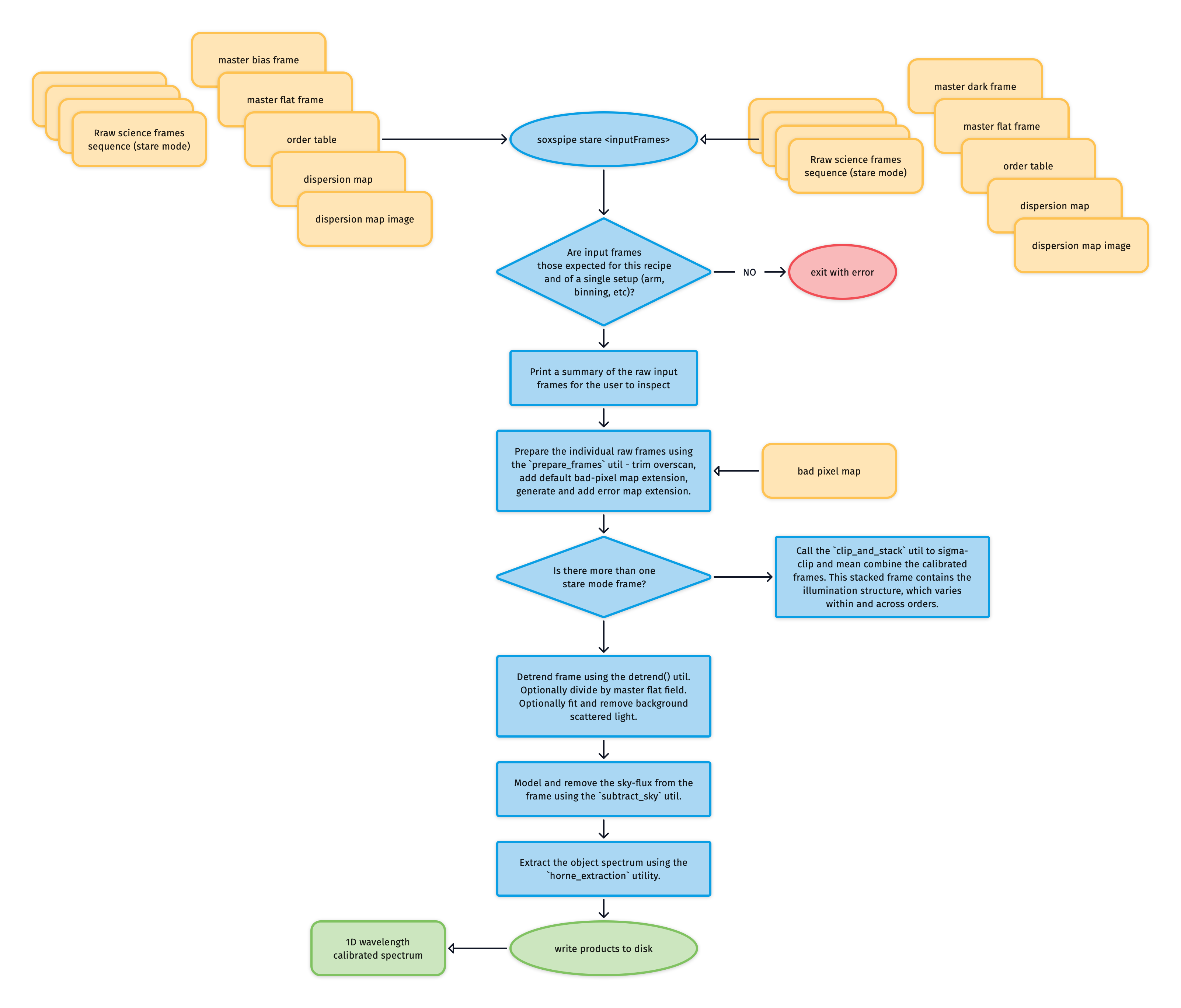
Fig. 49 The soxs_stare recipe algorithm. At the top of the diagram, NIR input data is found on the right and VIS on the left.
If more than one stare mode frame is passed to the soxs_stare recipe, there is a call to clip_and_stack to combine the data into a single frame. The single stare-mode frame is detrended using the detrend, optionally dividing by a master flat field and fitting and removing the background scattered light. The sky-flux is modelled and removed using the subtract_sky util, and finally, the object is optimally extracted using the horne_extraction utility.
Note a boxcar extraction is also preformed alongside the Horne extraction. Use the horne-extraction-slit-length to control the size of the aperture used to preform the boxcar extraction on the object trace.
Output
Label |
Content |
Data Type |
PRO CATG |
PRO TYPE |
PRO TECH |
|---|---|---|---|---|---|
|
Table of the extracted source in each order |
FITS |
|
|
|
|
Table of the extracted, order-merged |
FITS |
|
|
|
|
Table of the flux calibrated extracted spectrum |
FITS |
|
|
|
|
The sky-subtracted object |
FITS |
- |
- |
- |
|
The sky background model |
FITS |
- |
- |
- |
|
The sky subtraction residuals |
FITS |
- |
- |
- |
|
Response function coefficients |
FITS |
|
|
|
|
Efficiency estimate |
FITS |
|
|
|
|
Ascii version of extracted source spectrum |
TXT |
- |
- |
- |
|
Fitted intra-order image background |
- |
- |
- |
|
|
QC plots for the sky-background modelling |
- |
- |
- |
|
|
Sky-subtraction quicklook |
- |
- |
- |
|
|
Residuals of the object trace polynomial fit |
- |
- |
- |
|
|
QC plot of extracted source |
- |
- |
- |
|
|
QC plot of extracted order-merged source |
- |
- |
- |
|
|
QC plot of extracted order-merged, flux-calibrated source |
- |
- |
- |
|
|
Response curve QC plot. |
- |
- |
- |
QC Metrics
Label |
Description |
Unit |
Acceptable Range |
|---|---|---|---|
|
Fraction of bad pixels |
VIS: [0.0,0.01], NIR: [0.00,0.01] |
|
|
Mean inner-order pixel value |
electrons |
VIS: [-40,60], NIR: [-40,60] |
|
Sum of all inner-order pixel values |
electrons |
- |
|
Number of bad pixels |
- |
|
|
Number of orders containing an object trace |
VIS: 4, NIR: 15 |
|
|
Number of samples where a continuum is detected |
- |
|
|
Fraction of samples where a continuum is detected |
VIS: [0.93,1.0], NIR: [0.7,1.0] |
|
|
Total number of samples along orders |
- |
|
|
Number of continuum sample clipped during solution fitting |
- |
|
|
Fraction of detected continuum samples clipped during solution fitting |
VIS: [0.0,0.2], NIR: [0.0,0.3] |
|
|
Maximum residual in continuum fit along x-axis |
px |
- |
|
Minimum residual in continuum fit along x-axis |
px |
- |
|
Std-dev of residual continuum fit along x-axis |
px |
VIS: [0.0,0.2] |
|
Maximum residual in continuum fit along y-axis |
px |
- |
|
Minimum residual in continuum fit along y-axis |
px |
- |
|
Std-dev of residual continuum fit along y-axis |
px |
NIR: [0.0,0.5] |
|
The median efficiency (global) |
VIS: [0.04,0.30], NIR: [0.02,0.2] |
|
|
The median signal-to-noise ratio across all orders (global) |
VIS: [50,1000], NIR: [7,200] |
|
|
The median efficiency (order N) |
- |
|
|
The median signal-to-noise ratio across all orders (order N) |
- |
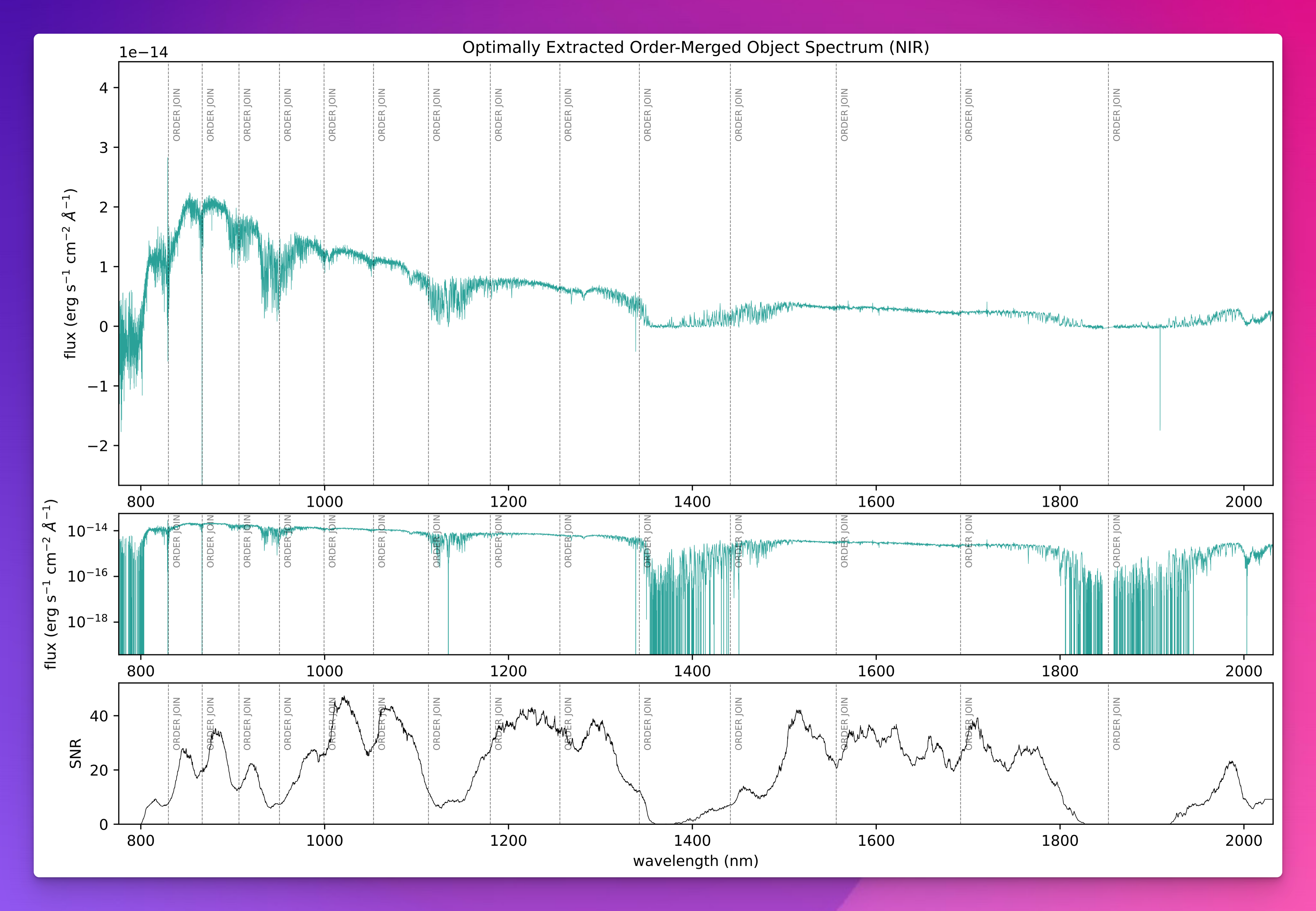
Fig. 50 A QC plot resulting from the soxs_stare recipe. This is a SOXS NIR wavelength and flux calibrated spectrum of the standard star CD-325613. The top- and middle-panels show the flux and wavelength calibrated spectrum, the top in linear-flux and the middle in log-flux scale. The bottom panel shows the signal-to-noise ratio across the entire wavelength range covered by the spectrum.
Recipe API
- class soxs_stare(log, settings=False, inputFrames=[], verbose=False, overwrite=False, command=False, debug=False, turnOffMP=False)[source]
Bases:
soxspipe.recipes.base_recipe.base_recipeReduce SOXS/Xshooter data taken in stare mode
Key Arguments
log– loggersettings– the settings dictionaryinputFrames– input fits frames. Can be a directory, a set-of-files (SOF) file or a list of fits frame paths.verbose– verbose. True or False. Default Falseoverwrite– overwrite the product file if it already exists. Default Falsecommand– the command called to run the recipedebug– show debug plots. Default FalseturnOffMP– turn off multiprocessing. True or False. Default False. If True, multiprocessing will be turned off and the recipe will run in serial. This is useful for debugging.
See
produce_productmethod for usage.Initialization
- produce_product()[source]
The code to generate the product of the soxs_stare recipe
Return:
productPath– the path to the final product
Usage
from soxspipe.recipes import soxs_stare
recipe = soxs_stare(
    log=log,
    settings=settings,
    inputFrames=fileList
)
stareFrame = recipe.produce_product()