soxs_disp_solution
The soxs_disp_solution recipe generates a first-guess dispersion solution for the instrument (measured along the central trace for each echelle order).
Usage
The soxs_disp_solution recipe can be run with the following convention:
soxspipe [-Vx] disp_solution <inputFrames> [-o <outputDirectory> -s <pathToSettingsFile> --poly=<od>]
To rerun a previously executed soxs_disp_solution recipe, you can find the execution command at the end of the recipe log file (found in the workspace products/soxs_disp_solution directory). Use the -x flag to overwrite the product files if they already exist. For example, from the root of your workspace, you would run a command like:
soxspipe disp_solution sof/20260111T095553_NIR_3_DSOL_PINHOLE_15_0S_SOXS.sof -s ./sessions/base/soxspipe.yaml -x
While the default polynomial fitting orders have been carefully tuned to robustly reduce most data, it is possible to execute this recipe while providing the dispersion-solution polynomial fitting orders through the command line, with command line settings overriding those in the YAML settings file. For instance, to attempt a dispersion solution fit using 3rd (x) and 4th-order (y) spectral-order (oo) component and a 5th-order (for both x and y) wavelength (ww) component:
soxspipe disp_solution sof/20260111T095553_NIR_3_DSOL_PINHOLE_15_0S_SOXS.sof -s ./sessions/base/soxspipe.yaml --poly=3455
To adjust the default settings for the soxs_disp_solution recipe, open the soxspipe.yaml file referenced in the command above in a text editor, navigate to the soxs_disp_solution dictionary, save the file and rerun the recipe command. The settings’ descriptions can be found in Table 9.
Product files are written in the products/soxs_disp_solution, and QC plots are in the qc/soxs_disp_solution workspace directory. A report of the product files, QC plots and metrics is also printed to the terminal. The QC metrics calculated for soxs_disp_solution are found in soxs_disp_solution_qc and a typical QC plot in soxs_disp_solution_qc_fig.
Reduction Tips
If this recipe fails because a fit for the dispersion solution is not found, the first parameter to adjust is poly-fitting-residual-clipping-sigma. Try setting a value lower than the default value by 0.5 and running the recipe again. If the recipe still fails, repeat the reduction in steps of 0.5 down to 3 sigma.
You can also try adjusting the polynomial fitting orders in order-deg, wavelength-deg and slit-deg. However, please be advised the pipeline itself will dynamically adjust these values if they fail to fit the default set. It will slowly reduce the orders and refit until it finds a fit or decides a fit can not be found (after five iterations of decreasing the orders).
Parameters
Parameter |
Description |
Type |
Entry Point |
Related Util |
|---|---|---|---|---|
|
the size of the square window used to search for an arc-lamp emission line, centred on the predicted pixel position of the line |
int |
settings file |
|
|
minimum significance required for arc-line to be considered ‘detected’ |
float |
settings file |
|
|
degree of echelle order number component of global polynomial fit to the dispersion solution [x, y] |
int/list |
settings file or command-line |
|
|
degree of wavelength component of global polynomial fit to the dispersion solution [x, y] |
int/list |
settings file or command-line |
|
|
number of sigma-clipping iterations to perform before settling on a polynomial fit for the dispersion solution |
int |
settings file |
|
|
sigma clipping limit when fitting global polynomial to the dispersion solution |
float |
settings file |
Input
Data Type |
Content |
Related OB |
|---|---|---|
FITS Image |
Arc Lamp through single pinhole mask |
|
FITS Image |
Master Dark Frame (VIS only, optional) |
- |
FITS Image |
Master Bias Frame (VIS only) |
- |
FITS Image |
Dark frame (Lamp-Off) of equal exposure length as single pinhole frame (Lamp-On) (NIR only) |
|
Output
Label |
Content |
Data Type |
PRO CATG |
PRO TYPE |
PRO TECH |
|---|---|---|---|---|---|
|
first pass dispersion solution |
FITS Table |
|
|
|
|
dispersion solution fitted lines |
FITS Table |
- |
- |
- |
|
undetected arc lines |
FITS Table |
- |
- |
- |
|
dispersion solution QC plots |
- |
- |
- |
QC Metrics
Label |
Description |
Unit |
Acceptable Range |
|---|---|---|---|
|
Total number of detected lines clipped during solution fitting |
lines |
- |
|
Number of lines detected in single pinhole frame |
lines |
- |
|
Proportion of input line-list lines detected on single pinhole frame |
VIS: [0.9,1.0], NIR: [0.9,1.0] |
|
|
Total number of line in single line-list |
lines |
- |
|
Proportion of good, unclipped lines in single pinhole frame |
lines |
- |
|
Maximum residual in fitting of pinholes along x-axis (global) |
pixels |
- |
|
Minimum residual in fitting of pinholes along x-axis (global) |
pixels |
- |
|
Median of absolute residuals in fitting of pinholes along x-axis (global) |
pixels |
VIS: [0.0,0.15], NIR: [0.0,0.35] |
|
Std-dev of residuals in fitting of pinholes along x-axis (global) |
pixels |
VIS: [0,0.4], NIR: [0,1.0] |
|
Maximum residual in fitting of pinholes along y-axis (global) |
pixels |
- |
|
Minimum residual in fitting of pinholes along y-axis (global) |
pixels |
- |
|
Median of absolute residuals in fitting of pinholes along y-axis (global) |
pixels |
VIS: [0.0,0.9], NIR: [0.0,0.13] |
|
Std-dev of residuals in fitting of pinholes along y-axis (global) |
pixels |
VIS: [0,1.2], NIR: [0,0.25] |
|
Maximum residual in fitting of pinholes (global) |
pixels |
- |
|
Minimum residual in fitting of pinholes (global) |
pixels |
- |
|
Median residual in fitting of pinholes (global) |
pixels |
NIR: [0,1.0] |
|
Std-dev of residuals in fitting of pinholes (global) |
pixels |
VIS: [0,1.5], NIR: [0,1.0] |
|
Median difference between observed and predicted pinhole detector locations along the x-axis (global) |
pixels |
- |
|
Std-dev in difference between observed and predicted pinhole detector locations along the x-axis (global) |
pixels |
VIS: [0,3.0], NIR: [0,1.3] |
|
Median difference between observed and predicted pinhole detector locations along the y-axis (global) |
pixels |
- |
|
Std-dev in difference between observed and predicted pinhole detector locations along the y-axis (global) |
pixels |
VIS: [0,10.0], NIR: [0,1.5] |
|
Median difference between observed and predicted pinhole detector locations (global) |
pixels |
NIR: [0,6.0] |
|
Std-dev of difference between observed and predicted pinhole detector locations (global) |
pixels |
NIR: [0,1.9] |
|
Median FWHM of detected lines in pinhole frames (global) |
pixels |
VIS: [1.60,1.75], NIR: [1.75,1.89] |
|
Std-dev in FWHM of detected lines in pinhole frames (global) |
pixels |
VIS: [0.1,0.2], NIR: [0,0.211] |
|
Median spectral resolution measured from detected lines in pinhole frames (global) |
- |
|
|
Maximum residual in fitting of pinholes along x-axis (order N) |
pixels |
- |
|
Minimum residual in fitting of pinholes along x-axis (order N) |
pixels |
- |
|
Median of absolute residuals in fitting of pinholes along x-axis (order N) |
pixels |
- |
|
Std-dev of residuals in fitting of pinholes along x-axis (order N) |
pixels |
- |
|
Maximum residual in fitting of pinholes along y-axis (order N) |
pixels |
- |
|
Minimum residual in fitting of pinholes along y-axis (order N) |
pixels |
- |
|
Median of absolute residuals in fitting of pinholes along y-axis (order N) |
pixels |
- |
|
Std-dev of residuals in fitting of pinholes along y-axis (order N) |
pixels |
- |
|
Maximum residual in fitting of pinholes (order N) |
pixels |
- |
|
Minimum residual in fitting of pinholes (order N) |
pixels |
- |
|
Std-dev of residuals in fitting of pinholes along (order N) |
pixels |
- |
|
Median difference between observed and predicted pinhole detector locations along the x-axis (order N) |
pixels |
- |
|
Std-dev in difference between observed and predicted pinhole detector locations along the x-axis (order N) |
pixels |
- |
|
Median difference between observed and predicted pinhole detector locations along the y-axis (order N) |
pixels |
- |
|
Std-dev in difference between observed and predicted pinhole detector locations along the y-axis (order N) |
pixels |
- |
|
Median difference between observed and predicted pinhole detector locations (order N) |
pixels |
- |
|
Median FWHM of detected lines in pinhole frames (order N) |
pixels |
- |
|
Std-dev in FWHM of detected lines in pinhole frames (order N) |
pixels |
- |
|
Median spectral resolution measured from detected lines in pinhole frames (order N) |
- |
The typical solution for the soxs_disp_solution recipe has sub-pixel residuals.
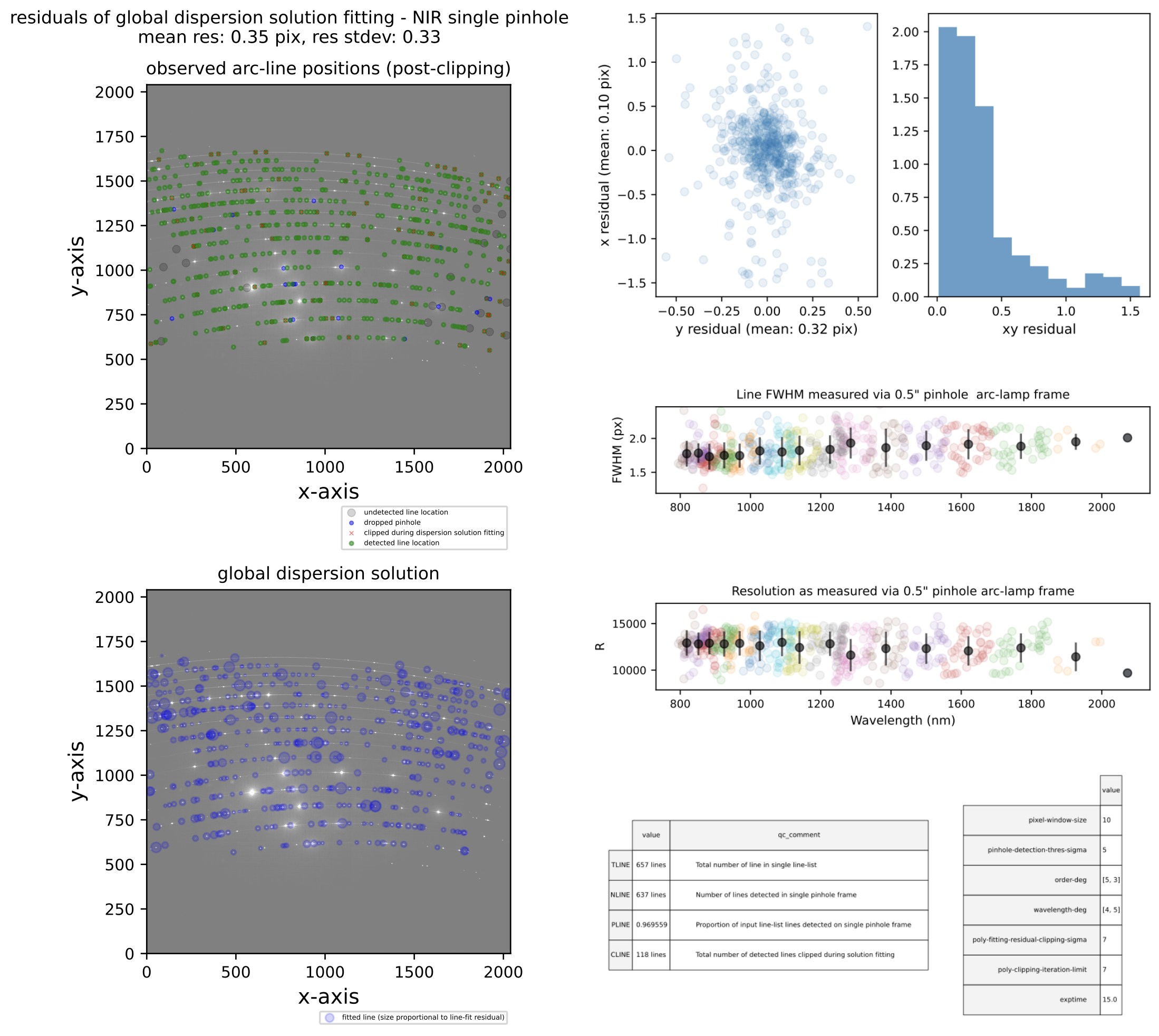
Fig. 13 A QC plot resulting from the soxs_disp_solution recipe as run on a SOXS NIR single pinhole arc lamp frame. A ‘good’ dispersion solution will have sub-pixel residuals (mean residuals \(<\) 0.5 pixels). The top-left panel shows an SOXS NIR arc-lamp frame, taken with a single pinhole mask. The green circles represent arc lines detected in the image, and the blue circles and red crosses were detected but dropped due to poor DAOStarFinder fitting or clipped during the polynomial fitting, respectively. The grey circles represent arc lines reported in the static calibration table that were not detected in the image. The bottom-left panel shows the same arc-lamp frame with the dispersion solution overlaid at the pixel locations modelled for the original lines in the line list. The top-right panels show the residuals of the dispersion solution fit, and the final panels (bottom-right) the resolution measured for each line (as projected through the pinhole mask) with different colours for each echelle order and the mean order resolution in black.