soxs_order_centres
Starting with the first pass dispersion solution from the soxs_disp_solution recipe, the soxs_order_centres recipe finds and fits a global polynomial model to the central trace of each echelle order.
Usage
The soxs_order_centres recipe can be run with the following convention:
soxspipe [-Vx] order_centres <inputFrames> [-o <outputDirectory> -s <pathToSettingsFile> --poly=<ooww>]
To rerun a previously executed soxs_order_centres recipe, you can find the execution command at the end of the recipe log file (found in the workspace products/soxs_order_centres directory). Use the -x flag to overwrite the product files if they already exist. For example, from the root of your workspace, you would run a command like:
soxspipe order_centres sof/20251011T094554_VIS_1X1_1_OLOC_QTH_PINHOLE_10_0S_SOXS.sof -s ./sessions/base/soxspipe.yaml
While the default polynomial fitting orders have been carefully tuned to robustly reduce most data, it is possible to execute this recipe while providing the order-trace polynomial fitting orders through the command line, with command line settings overriding those in the YAML settings file. For instance, to attempt a order trace fit using 3rd (x) and 6th-order (y) spectral-order (oo) component and a 4th-order (x) and 3rd-order (y) wavelength (ww) component:
soxspipe order_centres sof/20251011T094554_VIS_1X1_1_OLOC_QTH_PINHOLE_10_0S_SOXS.sof -s ./sessions/base/soxspipe.yaml --poly=3643
To adjust the default settings for the soxs_order_centres recipe, open the soxspipe.yaml file referenced in the command above in a text editor, navigate to the soxs_order_centres dictionary, save the file and rerun the recipe command. The settings’ descriptions can be found in Table 13.
Product files are written in the products/soxs_order_centres, and QC plots are in the qc/soxs_order_centres workspace directory. A report of the product files, QC plots and metrics is also printed to the terminal. The QC metrics calculated for soxs_order_centres are found in soxs_order_centres_qc and a typical QC plot in soxs_order_centres_qc_fig.
Reduction Tips
If this recipe fails the order centre traces, the first parameter to adjust is poly-fitting-residual-clipping-sigma. Try reducing this to 3-5 sigma and rerun the recipe to see if a fit is found. If the fit still fails, next try and increase the slice-width to 5-9 pixels to give the code a better chance of detecting the trace.
You can also try adjusting the polynomial fitting orders in order-deg and disp-axis-deg. However, please be advised the pipeline itself will dynamically adjust these values if they fail to fit the default set. It will slowly reduce the orders and refit until it finds a fit or decides a fit can not be found (after five iterations of decreasing the orders).
Parameters
Parameter |
Description |
Type |
Entry Point |
Related Util |
|---|---|---|---|---|
|
number of cross-order slices per order |
int |
settings file |
|
|
length of each slice (pixels) |
int |
settings file |
|
|
width of each slice (pixels) |
int |
settings file |
|
|
height gaussian peak must be above median flux to be “detected” by code (std via median absolute deviation). |
float |
settings file |
|
|
degree of y-component of global polynomial fit to order centres |
int |
settings file or command-line |
|
|
degree of echelle order number component of global polynomial fit to order centres |
int |
settings file or command-line |
|
|
sigma clipping limit when fitting global polynomial to order centres |
float |
settings file |
|
|
maximum number of clipping iterations when fitting global polynomial to order centres |
int |
settings file |
Input
Data Type |
Content |
Related OB |
|---|---|---|
FITS Image |
Flat lamp through a single-pinhole mask |
|
FITS Image |
Master Dark Frame (VIS only, optional) |
- |
FITS Image |
Master Bias Frame (VIS only) |
- |
FITS Image |
Dark frame (Lamp-Off) of equal exposure length as single-pinhole frame (Lamp-On) (NIR only) |
|
FITS Table |
First guess dispersion solution |
- |
Output
Label |
Content |
Data Type |
PRO CATG |
PRO TYPE |
PRO TECH |
|---|---|---|---|---|---|
|
Polynomial fits to the order centre traces |
FITS |
|
|
|
|
Residuals of the order centre polynomial fit |
- |
- |
- |
QC Metrics
Label |
Description |
Unit |
Acceptable Range |
|---|---|---|---|
|
Number of order centre traces found |
- |
|
|
Number of samples where a continuum is detected |
- |
|
|
Fraction of samples where a continuum is detected |
VIS: [0.85,1.0], NIR: [0.80,1.0] |
|
|
Total number of samples along orders |
- |
|
|
Number of continuum sample clipped during solution fitting |
- |
|
|
Fraction of detected continuum samples clipped during solution fitting |
- |
|
|
Maximum residual in order centre fit along x-axis |
px |
- |
|
Minimum residual in order centre fit along x-axis |
px |
- |
|
Std-dev of residual order centre fit along x-axis |
VIS: [0,0.1] |
|
|
Maximum residual in order centre fit along y-axis |
px |
- |
|
Minimum residual in order centre fit along y-axis |
px |
- |
|
Std-dev of residual order centre fit along y-axis |
NIR: [0,0.1] |
Plots similar to the one below are generated after each execution of soxs_order_centres. The residuals of a ‘good’ fit typically have a mean and standard deviation of <0.2px.
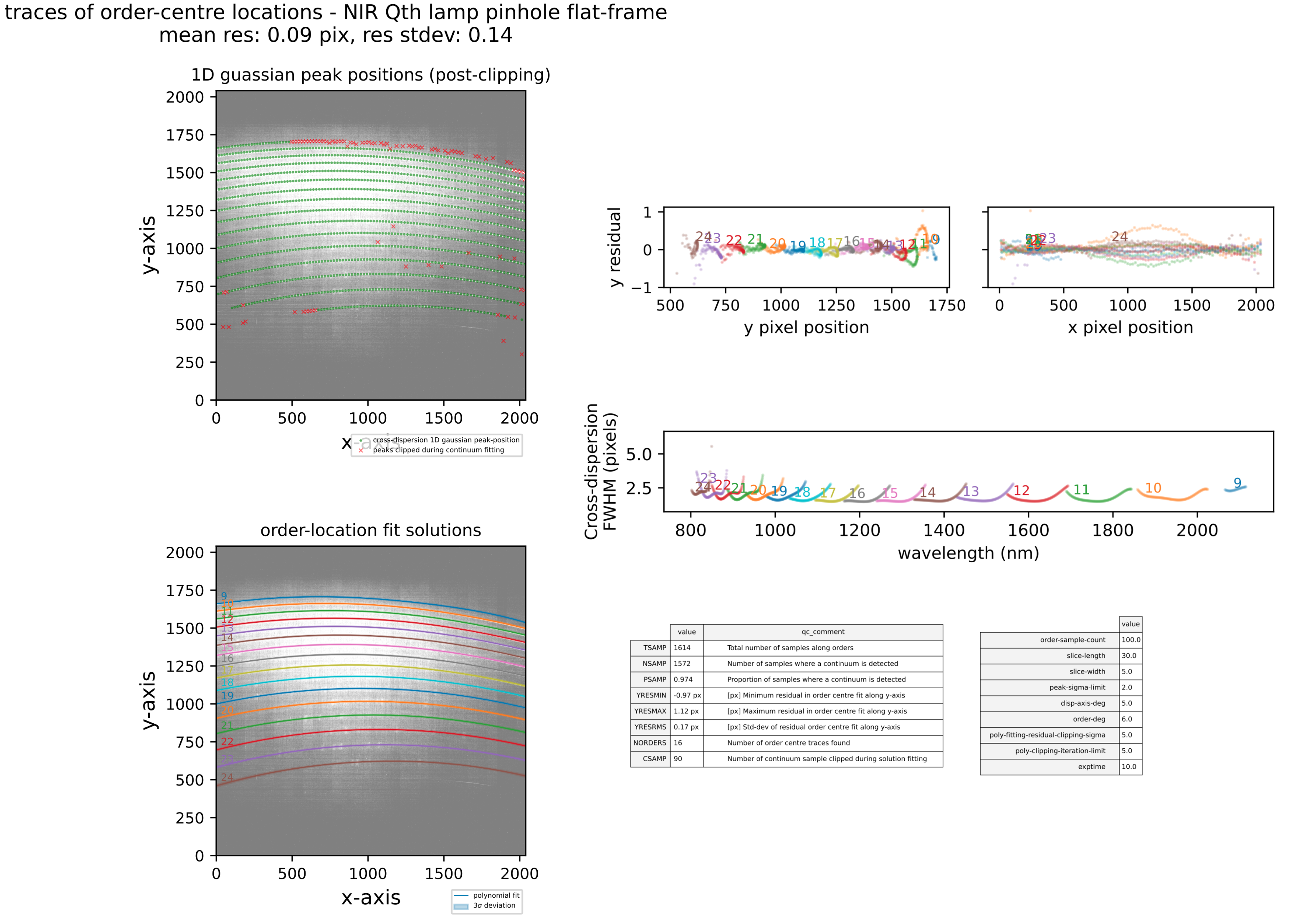
Fig. 14 A QC plot resulting from the soxs_order_centres recipe as run on a SOXS NIR single pinhole QTH flat lamp frame. The top-left panel shows the frame with green circles representing the locations on the cross-dispersion slices where a flux peak was detected. The red crosses indicate the centres of the slices where a peak was not detected. The bottom-left panel shows the global polynomial fitted to the detected order-centre trace with the different colours representing individual echelle orders. The top-right panels show the fit residuals in the X and Y axes. The bottom-right panel shows the FWHM of the trace fits (in pixels) as a function of echelle order and wavelength.